



Maintaining high service levels for support call centers
5 min97% of people say that customer service is crucial to retaining their loyalty according to Microsoft research.
It’s a no-brainer - for a call center to be a success, it needs to deliver excellent customer service and a great overall experience. But it’s not immediately obvious what this entails.
What, exactly, constitutes excellent customer service? How quickly should calls be answered? What does the average customer expect in terms of contact options, responsiveness and query resolution speed?
This article will take a deep dive into what high service levels look like for call centers and how to maintain them.
Industry Standards for Responsiveness
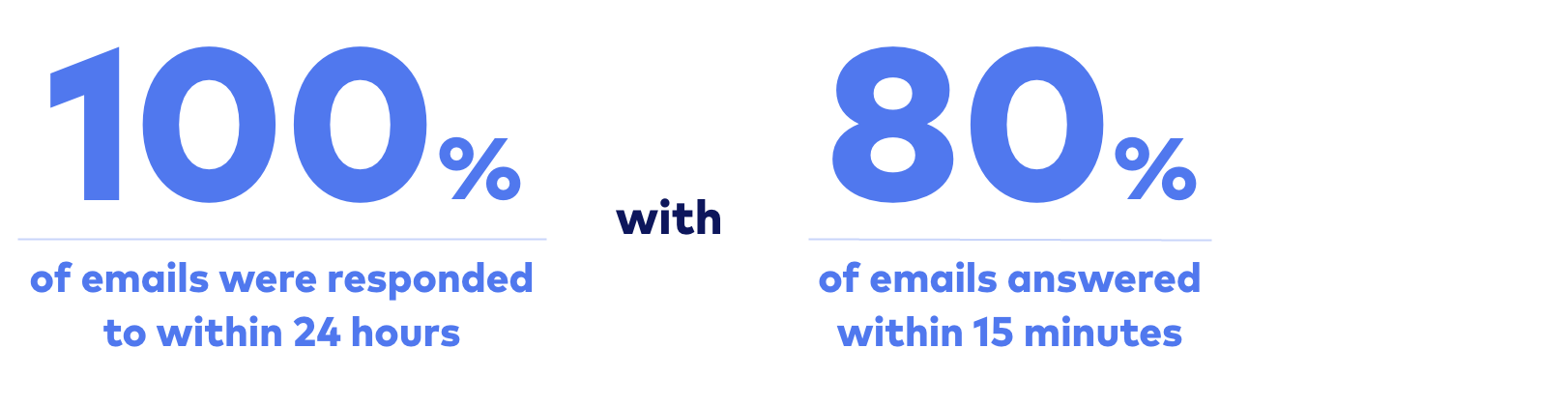
A recent large-scale call center survey revealed the following results as expected standards at the best contact centers:
Voice calls

Live chats

SMS or text messaging apps

Postal letters

As you can see, at contact centers that are regarded as offering a good or excellent service, the standards are high, with a strong focus on rapid responses.
First call resolution (FCR) is a good metric to monitor as an indicator of quality of service. The industry average for FCR is 74%, with the best call centers achieving rates as high as 90%.
Quality of Service

As well as the speed of response, the quality of the call center agent response is also an important factor. In general, the following criteria should be met by call center agents:
Knowledgeable
Agents should have all the information they need to hand, ready to answer common queries as quickly as possible. Successful call centers have easy-to-access knowledge banks or “cheat sheets” available to agents which enable them to provide swift, efficient service.
Communication Skills
Good call centers ensure that their agents have good interpersonal skills, are easy-to-understand, and offer a calm, polite service. Any gaps should be filled with extra training.
Adaptability
Sometimes customers want query resolutions to be carried out across multiple channels. Agents should be prepared to contact or follow-up with customers across more than one communication channel.
Organisational Skills
Handling call center workflows and volume can be challenging, especially during peak times, so agents need to be organised and flexible at times. Managers also need to build in some flexibility into workforce planning to allow for fluctuations in volume or staffing issues. Also, managers can work to improve the accuracy of call forecasting and make sure that there are enough staff scheduled in to cover high volume periods.
Maintaining High Standards with Quality Assurance (QA) Scoring
The next question is how can these high standards be consistently maintained?
The answer lies in robust monitoring, measuring, and feedback. In other words, call center managers need to plan what aspects of call to monitor, collect the necessary data, then feedback the results to agents, along with training on how to improve.
The industry standard is to randomly score at least four agent calls per month, but research has shown that 41% of call centers carry out call monitoring at a lower frequency than this.
- A good call center QA Scoring strategy will include the following metrics:
- Customer Satisfaction (CSAT) which reveals how well the call center is serving its customers overall.
- Agent Satisfaction (ASAT) gives an indication as to how motivated, engaged and dedicated call center staff are, which will have a knock-on effect to the CSAT score.
- First Call Resolution (FCR) is an operational metric that will affect CSAT.
- Average Handling Time (AHT) similar to FCR, this is an operational metric that will increase levels of customer satisfaction.
- Net Promoter Score (NPS) is a measure of overall customer experience by asking whether customers would recommend the product or service to others.
There are plenty of other metrics that you can record and monitor to gain even more granular detail, but you shouldn’t try to measure everything. It is more effective to stay focussed on the important data and QA scores, i.e. the ones that deliver the highest levels of success.
How To Provide Evaluation Feedback to Agents
Once you have set up your QA monitoring system and you are actively recording and analysing at least four calls per month, the next step is to provide feedback. An evaluation report should cover three key areas:
Compliance
Ensuring the right information is being given and queries are resolved in compliance with rules and regulations.
Process
Feedback should include statements related to process and workflows comparing the agent’s performance with industry best practices. The operational metrics such as FCR and AHT can be highlighted here.
Customer Experience
The CSAT metric can be shared with the agent to create a discussion on how well they are communicating and resolving customer issues.
Using Digital Technology To Drive Up Standards
A powerful way to monitor and evaluate call center performance is to integrate digital technology with voice calling.
Software solutions such as PhoneIQ allow you to record and gather data on calls that link up with your existing communication platforms, such as Microsoft Teams. You can automatically collect data on average handling time and customer satisfaction and run analysis to generate quality assurance scores.
Summary
Call centers need to focus on continuous improvement and consistency when it comes to providing high service levels. A strategy should be in place to monitor and give feedback in key quality assurance areas such as customer satisfaction and first call resolution rates.
Finally, technology that integrates voice calls with digital communication platforms can be used to save time and money.